What Developers Need in the Age of AI: The Essential Skills Beyond Code
AI is transforming software engineering faster than ever. While AI coding tools can generate syntax in seconds, the true competitive advantage now belongs to developers who master business problem-solving, system design, clear communication, and AI orchestration.
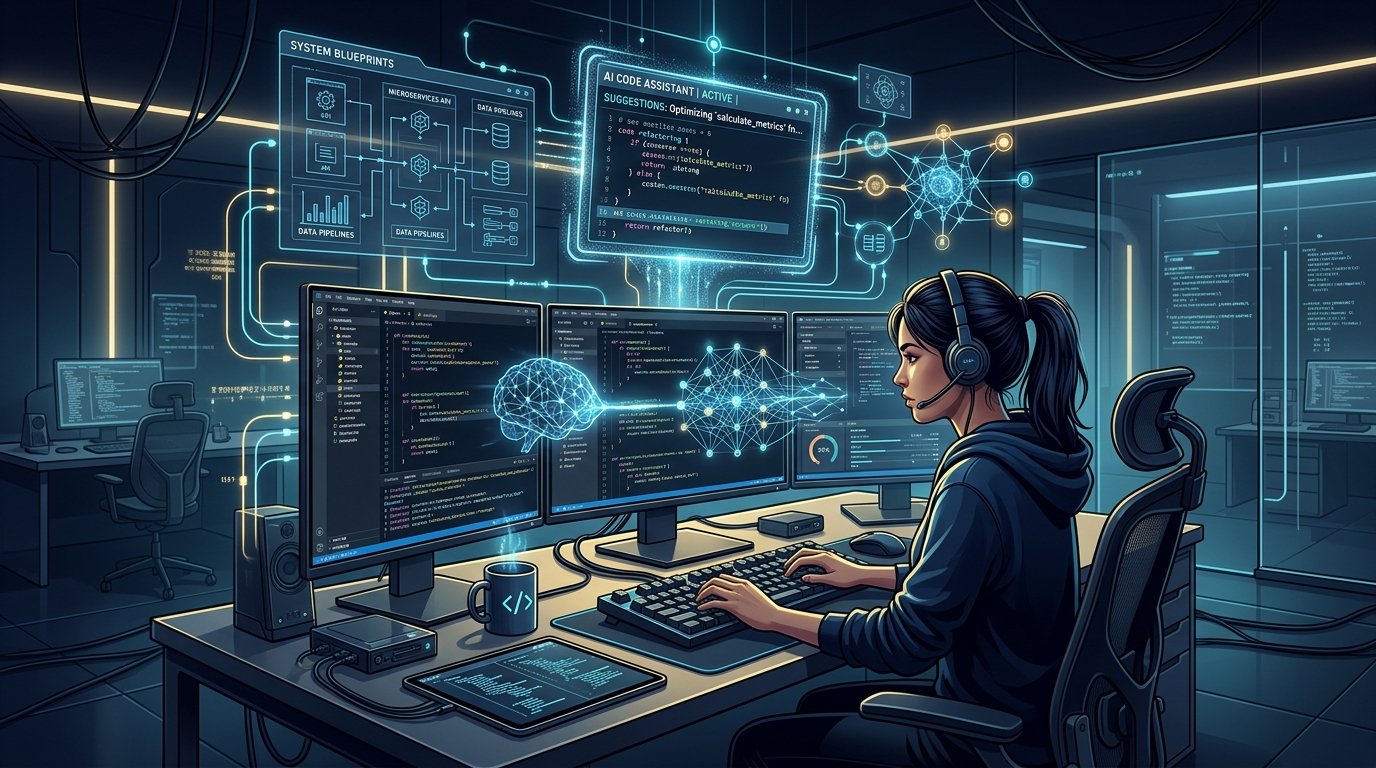
The Speed of the AI Shift in Software Engineering
Today, tools like AI coding assistants generate robust code on demand, platforms like Google Flow streamline generative media creation, and automated agent frameworks simplify testing, API integration, and deployment orchestration. In the coming years, these tools will become exponentially more capable, autonomous, and integrated into every stage of development.
Does AI Make Developers Less Important?
The resounding answer is no. Developers are not fading away, but the traditional definition of a developer's value has changed forever.
The biggest advantage in modern software engineering is no longer simply knowing how to write syntax. AI can already generate code, write unit tests, and autocomplete functions. The true, irreplaceable advantage now lies in creativity, first-principles problem-solving, architectural decision-making, and knowing exactly what to build, why to build it, and how it serves real business goals.
From Syntax Typists to Solution Architects
Developers must elevate their thinking beyond the code editor. As engineers, we must understand the underlying business problem, evaluate user experience, find the cleanest architectural solution, and leverage modern technologies like custom web application development to turn strategic goals into high-performing digital systems. AI is a formidable accelerator, but strategic direction, architectural guardrails, and quality governance must always come from human engineers.
The Critical Superpower: Focus in an Era of Infinite Output
Having endless options can easily lead to decision paralysis, architectural bloat, and wasted development cycles. Disciplined developers maintain razor-sharp focus on business value, system resilience, and user experience, filtering signal from noise and avoiding the temptation of chasing every shiny new tool without clear purpose.
The T-Shaped Polymath: Why Single-Skill Dependency is a Risk
A well-rounded developer understands backend architecture, frontend performance, cloud infrastructure, UI/UX design principles, and technical SEO foundations. If you work inside an enterprise team, having a broader skill set amplifies your problem-solving range and makes you indispensable. If you are a freelancer or agency founder, cross-disciplinary mastery allows you to deliver complete, production-ready solutions that directly drive client growth.
Communication and Trust: The Timeless Competitive Advantage
You can be an exceptional coder, but if you cannot explain your architectural ideas in stakeholder meetings, understand the unspoken nuances of a client's problem, discuss trade-offs with your team, or articulate your solution in plain language, your technical brilliance remains bottled up. Good communication builds trust, and trust is the foundational currency of every successful business, engineering team, and client partnership.
Collaborating with AI Instead of Competing Against It
By integrating practical AI automation and intelligent workflows into your development pipeline, you can eliminate repetitive chores, generate comprehensive test cases, validate security assumptions, and focus your cognitive energy on complex system design. However, as we explore in our guide on why good developers fail on enterprise systems, AI should never replace human validation, rigorous code reviews, and deep understanding of data lifecycles.
Cultivating the Right Mindset for the Future
"How can I become a developer who is even more valuable because of AI?"
That mindset shift makes all the difference. AI can make our workflows faster, simplify repetitive tasks, and accelerate execution. But creativity, curiosity, communication, critical thinking, and the ability to understand real-world human problems are qualities we must cultivate ourselves.
Conclusion: The Future Belongs to the Thinkers and Builders
If your business is ready to build scalable, AI-empowered web applications, CRM systems, or automated digital platforms, explore how Verse Next can help you engineer modern software solutions tailored for long-term growth.
Frequently asked questions
Will AI replace software developers in the near future?
AI will automate routine coding tasks, boilerplate generation, and basic bug fixes, but it cannot replace the strategic thinking, system architecture, business domain understanding, and client communication that human engineers provide.
What skills are most important for developers in the AI era?
Beyond programming fundamentals, developers need strong problem-solving skills, system architecture expertise, clear business communication, focus in filtering AI outputs, cross-disciplinary full-stack knowledge, and the ability to review and secure AI-generated code.
How can developers safely use AI coding assistants without introducing bugs?
Treat AI output as a draft from a junior contributor. Always understand the generated logic, verify edge cases, inspect security and data lifecycle implications, run thorough unit and integration tests, and ensure compatibility with production infrastructure.
Why is communication considered a crucial skill for technical developers?
Technical skills only create value when aligned with real business needs. Clear communication enables developers to understand client requirements, align teams, negotiate technical trade-offs, and build lasting professional trust.
How does having a multidisciplinary (T-shaped) skill set help a programmer?
A T-shaped developer combines deep expertise in their primary specialty with broad knowledge of frontend, backend, databases, UI/UX, SEO, and deployment pipelines, making them resilient to industry shifts and capable of delivering complete end-to-end solutions.
Share this article
Need this for your business?
Verse Next can plan the strategy, content structure, SEO foundation, and technical implementation for your website, software platform, or AI automation workflow.