AI is changing the work, not the whole profession
Artificial intelligence has changed software development faster than many developers expected. A few years ago, most developers solved problems through documentation, Google, online courses, forums, and their own trial and error. Now tools such as Codex, GitHub Copilot, ChatGPT, Cursor, and AI coding agents can read codebases, generate features, fix bugs, write tests, prepare documentation, and build working applications from written instructions.
The fear is understandable
New developers are asking whether learning programming is still worth it. Junior developers worry that companies will hire fewer people. Freelancers see more pressure on Fiverr and Upwork. Experienced developers also wonder how valuable years of technical knowledge will be when AI can produce code in minutes. Those concerns are real, but the idea that AI will simply replace software developers is too shallow.
Software demand is still growing
AI is not removing the need for software. Businesses still need websites, mobile apps, dashboards, APIs, automation systems, AI agents, portals, reporting tools, and custom digital products. What is changing is how those products are built. Companies will reward developers who understand real problems, design reliable systems, direct AI tools, review generated code, maintain production applications, and turn technology into business results.
The developer role is moving toward judgment
The future will be harder for people who only memorize syntax, copy code, or repeat the same basic projects. It will be better for developers who can plan, question, test, debug, communicate, and take responsibility. AI can write code, but it cannot own the result. A developer still needs to know whether the generated work is secure, maintainable, useful, and correct for the business.
My view as a developer building Verse Next
I see this shift from two sides. I work as a developer, and I am also building Verse Next as a technology business. In a job, I need to keep improving so I can solve larger problems. In business, I need to deliver quality work faster, understand what clients actually need, and create systems that save time, reduce costs, or generate revenue. In both cases, continuous learning is no longer optional.
Will AI replace software developers?
AI will replace some tasks, but a task is not the same as a full profession. Boilerplate code, simple landing pages, basic CRUD screens, repetitive tests, documentation drafts, and common bug fixes can already be completed faster with AI. Smaller teams may deliver more work than before. Still, a production application needs requirement analysis, architecture, data protection, roles and permissions, third-party integrations, monitoring, deployment, and responsibility when something fails.
Code generation still needs human review
AI can suggest a database structure, but it does not automatically know what a business must retain for operational or legal reasons. AI can generate authentication, but a developer must review its security. AI can design an attractive workflow, but it may not understand why real users abandon it. AI can fix one visible error and introduce another problem somewhere else. Speed without verification is not engineering.
Entry-level development is more competitive
For years, a beginner could learn HTML, CSS, JavaScript, PHP, or a popular framework, build a few portfolio projects, and start competing for basic website work. That path still exists, but it is more crowded. More people are entering development, clients can choose from thousands of freelancers, website builders and templates are better, and AI helps experienced developers produce more work in less time.
Learning coding is still worth it
New developers should still learn software development, but they should change how they learn. Do not spend years memorizing every concept before building real projects. Also do not ask AI to create full applications while you remain unable to explain the code. Learn the concept, build a small version yourself, use AI to improve it, review every change, break the app on purpose, debug it, deploy it, and watch how it behaves in a real environment.
Fundamentals matter more when AI writes code
Every new developer should understand variables, functions, conditions, loops, arrays, objects, common data structures, object-oriented and functional ideas, async programming, APIs, databases, authentication, authorization, validation, error handling, Git, debugging, logs, testing, and basic design principles. These basics help you judge AI-generated code instead of trusting it because it ran once locally.
Master one complete development stack
Beginners often jump from React to Flutter, then Python, Java, Laravel, Node.js, and several AI tools. They collect tutorials but never finish a production application. Choose one stack and learn it deeply enough to build, secure, deploy, and maintain a complete product. For web development, that may mean HTML, CSS, JavaScript, TypeScript, React, Next.js, Laravel or Node.js, MySQL or PostgreSQL, REST APIs, Git, GitHub, hosting, deployment, and basic server management.
AI-assisted development is now a core skill
Developers should learn how to use AI tools to understand unfamiliar codebases, plan features, generate repetitive boilerplate, refactor duplicated code, write tests, investigate logs, document APIs, review security risks, compare technical approaches, and automate repetitive development tasks. Good AI work is not about one clever prompt. It is about context, requirements, constraints, examples, relevant files, acceptance criteria, and careful verification.
Developers should understand AI agents
Basic chatbots are only one part of AI. Developers should learn how AI agents interact with APIs, documents, databases, communication platforms, and business workflows. Useful topics include model APIs, structured outputs, tool calling, retrieval, embeddings, vector databases, agent workflows, context management, document processing, human approval, evaluation, prompt-injection protection, usage tracking, and cost control.
Business automation is where AI becomes valuable
An AI agent becomes commercially useful when it safely performs real work. It might classify customer requests, summarize documents, prepare responses, update a CRM, generate reports, organize leads, or assign tasks to the right department. At Verse Next, this direction matters because the real opportunity is combining web applications, custom software, and AI automation to solve operational problems, not adding AI as a label.
System design will separate strong developers
When AI makes coding faster, weak technical decisions can spread faster too. Developers who understand system design can decide whether a process should run immediately or through a queue, what happens when an API fails, how roles and permissions should work, what data should be cached, how failed jobs should retry, where logs belong, and how important business data should be backed up.
Testing and security are future-proof skills
AI can generate code that looks professional but contains hidden mistakes. Developers should understand unit testing, integration testing, full workflow testing, input validation, secure authentication, role-based access control, SQL injection prevention, cross-site scripting protection, CSRF protection, secrets management, dependency security, rate limiting, database backups, and safe deployment practices. AI-generated code should be treated like code from an unfamiliar contributor.
Production skills create a real advantage
Many courses stop when the app works on a local computer. Businesses pay for software that keeps working for real users. Developers should learn Linux basics, domains, DNS, SSL, environment variables, CI/CD pipelines, Docker, queues, scheduled jobs, cloud storage, monitoring, logs, database backups, performance optimization, rollback, and recovery. Production experience connects code with business continuity.
Product thinking matters
Clients rarely need a React website or Laravel dashboard because the technology is popular. They need more leads, fewer manual steps, better reporting, faster operations, improved customer service, or lower costs. Product thinking means asking who will use a feature, what problem they are solving, what workflow is simplest, what information is essential, what may confuse users, and how success will be measured.
Communication turns code into the right system
Technical knowledge helps you build a system. Communication helps you build the correct system. Developers should ask clear questions, understand client requirements, summarize technical decisions, estimate honestly, explain trade-offs, report progress, discuss budgets, document workflows, and raise risks before they become expensive problems.
A practical roadmap for new developers
Start with one programming language, Git, databases, HTTP, APIs, authentication, validation, and debugging. Then build two or three real applications with user roles, database relationships, file uploads, API integrations, error handling, and deployment. Add AI to your workflow, build a focused AI-powered product, learn production engineering, and choose a business niche where your technical skills solve a specific kind of problem.
What employed developers should do
If you already have a software development job, do not wait for your company to build a learning plan. Identify repetitive work in your role and use approved AI tools to reduce time spent on documentation, testing, debugging, reporting, or repetitive implementation. Move closer to architecture, API integrations, performance, security, production support, requirement analysis, and communication with stakeholders.
What developers building a business should do
If you are building an agency, freelance business, software company, or SaaS product, AI gives leverage only when it is combined with clear positioning and client trust. Instead of offering every possible service to everyone, provide a specific result for a specific type of client. Use AI for research, proposals, prototypes, tests, documentation, and delivery, but never promise work you cannot understand, secure, or maintain.
Freelance web development is not dead
Low-differentiation freelancing is under pressure. A client who needs a basic page can choose templates, website builders, low-cost freelancers, and AI tools. Higher-value freelance work includes integrations, production support, workflow automation, platform security, custom dashboards, AI features using private company knowledge, long-term maintenance, SEO analytics, and solving problems inside existing codebases.
Do not chase every new tool
Staying updated does not mean changing your workflow every week. Before spending serious time on a new framework, model, agent, or platform, ask whether it solves a regular problem, improves speed or quality, works with your stack, produces output you can verify, and teaches a skill that remains useful if the tool disappears.
The next decade belongs to developers with clear concepts
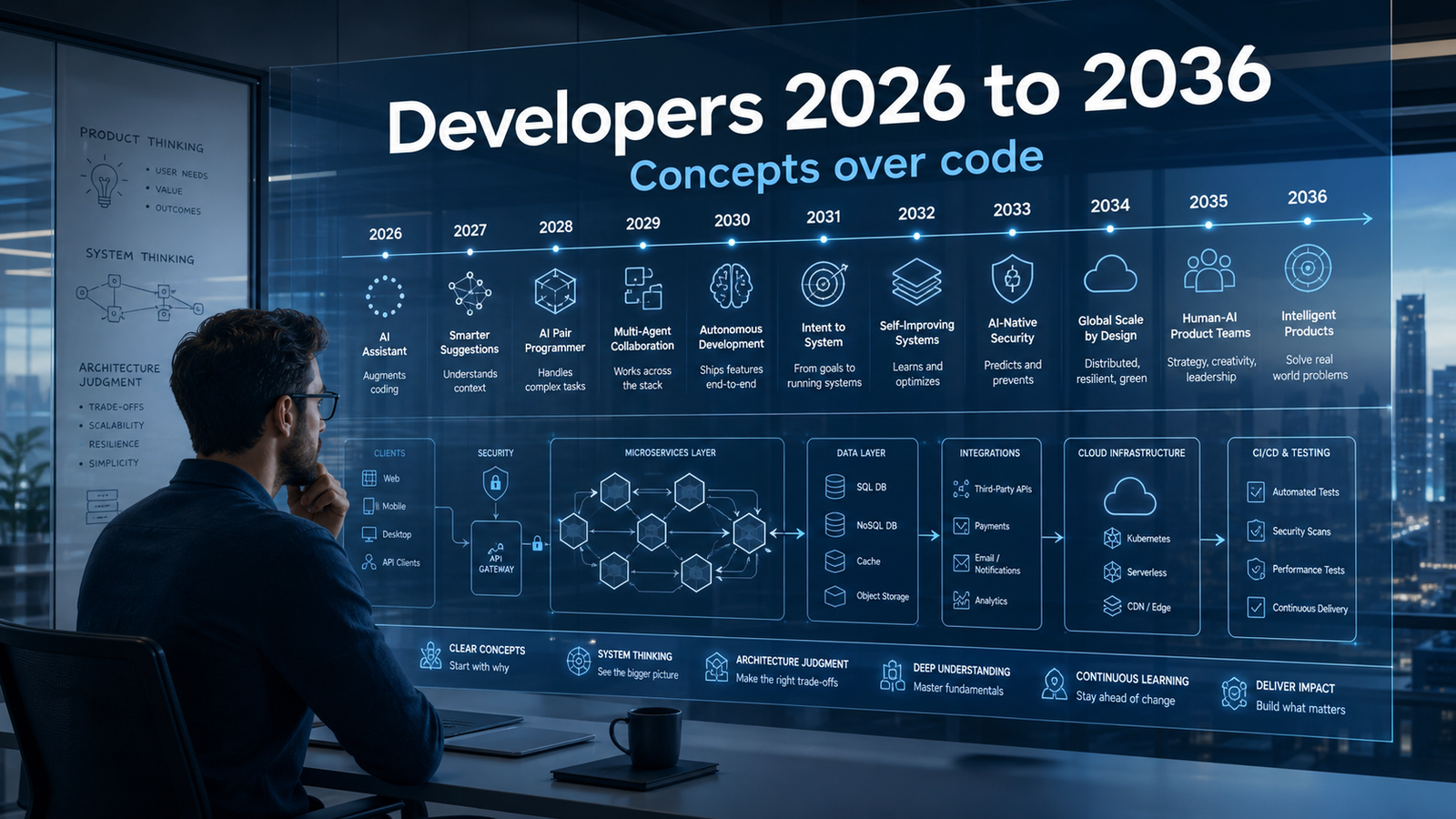
From 2026 to 2036, more code will be generated with AI assistance. Someone still has to decide what should be built, how it should work, and whether it is safe and correct. The developer's value is moving from syntax toward problem-solving, from manual implementation toward system direction, from isolated coding toward product ownership, and from tool knowledge toward technical judgment.
Final thoughts
The future of software developers in the age of AI will not be a simple competition between humans and machines. Some repetitive tasks will disappear, teams may become smaller, and entry-level work may stay competitive. But developers who understand systems, users, security, business requirements, production environments, and AI will continue to create value. Build your career around learning, adapting, communicating, and solving problems.
How Verse Next can help
If you are planning an AI-powered website, custom application, business automation system, or scalable digital product, Verse Next can help plan, build, and improve it with modern software development and practical AI automation.